Website Guides
Website for Construction Companies in Malaysia: What Should It Include to Generate B2B Enquiries & Project Opportunities?
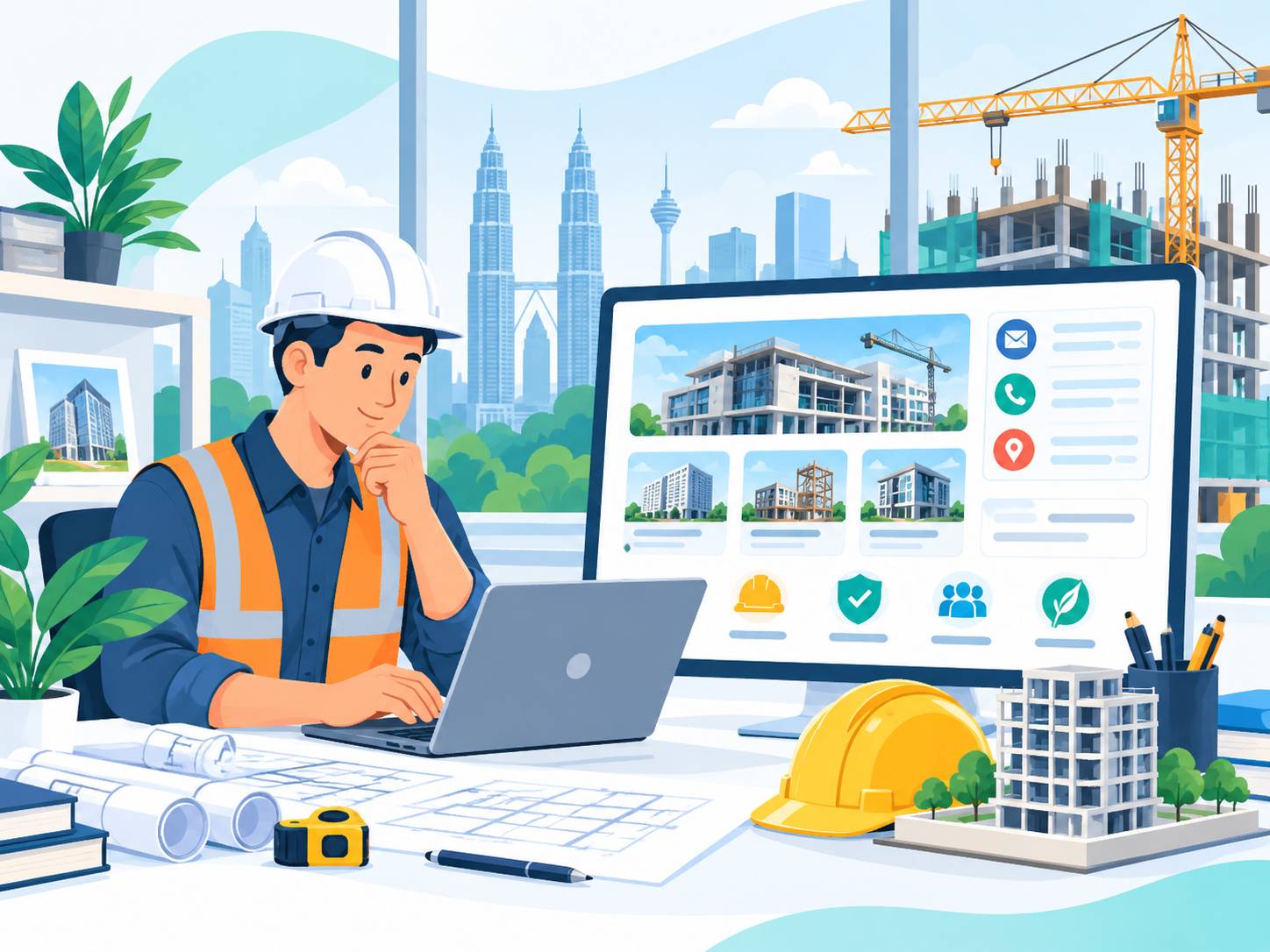
Quick answer: a website for a construction company in Malaysia should do much more than display a few project photographs, the company logo and a telephone number. It should help potential clients understand what type of construction work your company performs, which sectors you serve, what your company is capable of delivering, the projects you have completed, which relevant credentials you hold, where you operate and how someone can begin a project discussion or submit an enquiry.
For construction companies operating mainly in B2B markets, the website may also need to support several types of visitors — including developers, consultants, project managers, procurement teams, building owners, manufacturers, main contractors and potential business partners.
A strong website structure will normally consider:
- clear company positioning,
- construction services and capabilities,
- sectors or industries served,
- project portfolio,
- detailed project case studies,
- verifiable company registrations and credentials,
- quality and safety information where relevant,
- geographical coverage,
- company profile or capability statement,
- Request for Quotation or project enquiry forms,
- WhatsApp or direct-contact options,
- mobile-friendly experience,
- SEO-ready website architecture, and
- a practical way for your team to keep projects updated after launch.
This construction company website Malaysia guide explains how those elements can be structured so the website becomes more than an online company profile. It can also support credibility, project presentation, business development and the enquiry process.
A Construction Website Is Different from a Renovation or Engineering Website
Construction, renovation and engineering websites can overlap in certain areas, but the customer journey and information requirements are not necessarily the same.
| Website Type | Main Focus | Typical Audience |
|---|---|---|
| Construction Company | Project capability, delivery experience, sectors, credentials, RFQs and B2B credibility | Developers, consultants, procurement teams, project owners, main contractors and corporate clients |
| Renovation Company | Before-and-after projects, home or commercial renovation, service areas, quotations and local enquiries | Homeowners, office owners, tenants and property owners |
| Engineering Company | Technical disciplines, systems, engineering capability, industries and technical project experience | Technical buyers, engineers, facility managers, manufacturers and consultants |
If your business focuses mainly on home renovation, office renovation or interior improvement, read our website guide for renovation companies in Malaysia.
If your core business is M&E, electrical, mechanical, automation or another technical engineering service, the website guide for engineering companies in Malaysia may be more relevant.
This article focuses specifically on businesses that want to demonstrate their ability to deliver construction projects and generate B2B project enquiries.
What Is the Real Job of a Construction Company Website?
A construction company website normally needs to perform several jobs at the same time.
1. Explain What Your Company Can Actually Build or Deliver
Do not leave visitors with only a statement such as:
“Your Trusted Construction Partner.”
while they still cannot determine what your company actually does.
The homepage should help visitors understand areas such as:
- building construction,
- civil works,
- design and build,
- industrial construction,
- commercial construction,
- factory or warehouse projects,
- infrastructure works,
- fit-out works,
- specialist contracting, or
- other genuine scopes provided by your company.
Do not list services your company does not genuinely provide simply for SEO purposes.
2. Demonstrate Relevant Project Experience
Construction is an industry where real project experience can provide highly useful evidence of capability.
A prospective customer may want to understand:
- what types of projects you have completed,
- which sectors the projects belong to,
- where the projects were located,
- what scope your company performed,
- what role your company had,
- the project status,
- whether real photographs are available, and
- whether your previous work is relevant to their own requirement.
A strong portfolio helps answer:
“Has this company handled work similar to what we need?”
3. Build Confidence Before an RFQ or Tender Discussion
For B2B construction, a website does not necessarily close the sale directly.
Instead, it can be one of the places where potential clients conduct basic due diligence before continuing a discussion.
They may want to review:
- company background,
- services,
- project experience,
- relevant registrations,
- certifications,
- locations,
- contact details, and
- whether the overall company presentation is consistent with the stated capabilities.
4. Provide a Clear Enquiry Path
Once someone believes your company may be suitable, do not force them to search the footer for an email address.
The website can use calls to action such as:
- Request a Quotation
- Discuss a Project
- Send Project Enquiry
- Request Company Profile
- Contact Project Team
- WhatsApp Us
The CTA should reflect the way your actual sales or business-development team handles opportunities.
Who Might Visit a Construction Company Website?
The website may need to serve more than one audience.
Depending on the business, visitors may include:
- property developers,
- project owners,
- architects,
- consultants,
- quantity surveyors,
- procurement teams,
- project managers,
- manufacturing companies,
- facility owners,
- main contractors,
- subcontractors,
- suppliers,
- potential employees, and
- business partners.
This means the information hierarchy matters.
The homepage does not need to explain everything.
It needs to help each type of visitor reach the relevant information quickly.
Recommended Website Structure for a Construction Company
A practical starting structure could include:
- Home
- About Us
- Construction Services
- Capabilities
- Sectors / Industries
- Projects
- Project Case Studies
- Credentials / Certifications
- Quality / Safety where relevant
- News / Insights where required
- Careers if the company recruits regularly
- Contact / Request for Quotation
The actual structure should follow the size and business model of the company.
A contractor with only two main service lines does not need a 50-page website.
A larger main contractor operating across several sectors and regions may require a much deeper structure.
1. The Homepage Should Explain Your Positioning Quickly
The hero section should answer a few basic questions:
- Who are you?
- What type of construction work do you perform?
- What type of customers or projects do you serve?
- Where do you operate?
- What should the visitor do next?
A headline such as:
“Building Construction & Civil Works for Commercial and Industrial Projects”
usually communicates more useful information than:
“Building Excellence for Tomorrow.”
A branding tagline can still be used, but it should not be the only explanation of what the company does.
What Can Appear Near the Hero Section?
- short company positioning,
- main construction service,
- sector focus,
- service area,
- real project visual,
- View Projects CTA, and
- Discuss Your Project / Request Quotation CTA.
2. Separate Construction Services Clearly
Avoid placing every service inside one long paragraph.
If individual services have sufficiently different customer requirements and search intent, dedicated service pages can be more useful.
Depending on the company, examples may include:
- Building Construction
- Civil Engineering Works
- Design & Build
- Industrial Construction
- Commercial Construction
- Infrastructure Works
- Interior Fit-Out
- Maintenance & Upgrading Works
- Specialist Contracting
Each service page can explain:
- what the service involves,
- which types of projects it suits,
- the typical scope,
- relevant sectors,
- relevant project examples,
- geographical coverage, and
- how to submit a project enquiry.
3. Show the Sectors or Industries You Serve
A B2B buyer may not only ask:
“Do you provide construction services?”
They may be more interested in:
“Do you have experience with facilities or projects similar to ours?”
Relevant sectors may include:
- commercial buildings,
- industrial facilities,
- manufacturing,
- warehouses,
- residential developments,
- retail,
- hospitality,
- education,
- healthcare,
- government facilities, or
- infrastructure.
Use only sectors that genuinely reflect your company's capability or experience.
Do not add industries simply because they make the website appear more impressive.
4. The Project Portfolio Is One of the Most Important Sections
A construction portfolio should not be a gallery without context.
A photograph of a building alone does not explain:
- your company's role,
- the scope of work,
- the project category,
- the location,
- what was actually delivered, or
- whether the company acted as a main contractor, subcontractor or specialist contractor.
Where possible, each project should contain structured information.
Example Project Entry Structure
- Project: Project name where publication is permitted
- Sector: Industrial / Commercial / Residential / Infrastructure
- Location: Project location
- Role: Main contractor / specialist contractor / subcontractor where disclosure is permitted
- Scope: Actual scope delivered
- Status: Completed / Ongoing where relevant
- Completion: Year or period where appropriate
- Gallery: Approved project photographs
Project value, client identity, exact contract information or sensitive commercial details should only be published when the company has permission to disclose them.
5. Project Case Studies Are Stronger Than a Gallery Alone
For flagship projects, consider creating a dedicated case study.
A case study can help visitors understand not only what was built, but how your company approached the work.
Project Overview
Explain the project type, sector and context.
Client Requirement
Describe the main objectives or requirements that can be disclosed publicly.
Scope of Work
Explain what your company was actually responsible for delivering.
Delivery Approach
Describe the construction process, coordination or delivery approach at an appropriate level.
Challenges
Where suitable, explain genuine constraints or project challenges without revealing confidential information.
Outcome
Explain what was completed without inventing statistics or unsupported results.
Project Gallery
Use real site, progress and completed-project photographs where publication is permitted.
This gives prospective clients much more useful proof than displaying dozens of unexplained thumbnails.
6. Use Real Project Photography
Construction businesses often have a major content advantage: real projects generate strong visual evidence.
Useful images may include:
- completed buildings,
- site progress,
- structural works,
- interior works,
- machinery,
- site teams,
- project milestones,
- installation works, and
- before, during and after images where appropriate.
Make sure you have suitable permission before publishing site photographs, client property, personnel or project information.
Avoid relying heavily on generic stock photographs of cranes and skyscrapers when your company has genuine project evidence available.
7. Show Capabilities, Not Only Services
A service explains what you offer.
A capability helps potential clients understand what the organisation is able to deliver.
Depending on your company, capability content might cover:
- project management,
- site management,
- design coordination,
- construction planning,
- procurement coordination,
- quality management,
- safety management,
- testing and commissioning where relevant,
- machinery or equipment capability, or
- specialist technical resources.
Use only capabilities that genuinely exist within the business.
8. CIDB Registration and Other Credentials
For construction businesses in Malaysia, company registration and industry credentials can form an important part of credibility.
CIDB states that contractors are required to register before undertaking and completing construction work in Malaysia, subject to exemptions provided under the relevant legislation.
You can refer to the official CIDB Contractor Registration information for current details.
Where relevant and currently valid, a construction website may display information such as:
- CIDB registration details,
- contractor grade,
- relevant categories or specialisations,
- SPKK where genuinely held and applicable,
- ISO certifications,
- industry-specific licences,
- professional memberships, or
- other approved registrations.
Do not simply place badges on the website without verification.
If a certificate has a number, scope or expiry date that needs to remain current, establish a process for reviewing it.
Do not claim:
“CIDB G7 Contractor”
or display certification logos if the information cannot be verified or the relevant registration is no longer valid.
9. Quality, Safety and HSE Information
For certain construction companies, quality and safety information is important during B2B evaluation.
Where the company has genuine policies, processes or supporting evidence, the website can briefly explain:
- quality approach,
- site safety approach,
- HSE / SHE policy,
- internal procedures,
- relevant certifications, and
- training and competency approaches.
Do not use the website to make unsupported safety claims.
If policies are available as downloadable documents, make sure their version and date are still current.
10. Team and Leadership
Potential B2B clients may also want to understand who is behind the company.
A team page may feature:
- directors,
- management,
- project managers,
- engineers,
- quantity surveyors,
- technical personnel, or
- department heads.
There is no need to publish unnecessary personal information.
Focus on role, relevant qualifications, project experience and expertise that the company is comfortable making public.
11. Company Profile and Capability Statement
Many construction companies already have a PDF company profile.
That document can still be useful.
However, do not make the PDF the only place where visitors can understand the company.
Important information such as:
- services,
- projects,
- sectors,
- capabilities,
- credentials, and
- contact details
should normally also be available directly in HTML pages.
The company profile can remain a supporting downloadable resource for procurement teams or clients who want a document they can circulate internally.
12. Do Not Put the Entire Portfolio Inside One PDF
A common pattern is:
Homepage → Download Company Profile PDF → all project information exists only inside the PDF.
This is less useful for both visitors and SEO.
A stronger approach can include:
- a Projects listing page,
- project categories,
- individual project pages or case studies, and
- the PDF as a supporting resource.
This allows visitors to choose the projects most relevant to them without manually scrolling through a long company-profile document.
13. Organise Projects by Category
If your company has many projects, useful filters can help.
Examples might include:
- Industrial
- Commercial
- Residential
- Infrastructure
- Government
- Factories
- Warehouses
- Fit-Out
Use categories that reflect the actual portfolio.
Avoid creating twenty categories when most of them contain only one project.
14. Distinguish Ongoing and Completed Projects
If ongoing projects are shown publicly, distinguish them clearly from completed projects.
Status labels might include:
- Ongoing
- Completed
- Under Construction
Project status should also be maintained.
Do not leave a completed project marked as “Ongoing” for several years.
15. Request for Quotation or Project Enquiry Forms
A standard contact form may be enough for some contractors.
However, a B2B construction website may benefit from a slightly more structured project enquiry form.
Possible fields include:
- Name
- Company
- Phone
- Project type
- Project location
- Required service
- Estimated start period
- Short project description
Avoid demanding too much information before the first conversation.
If BOQs, drawings, specifications or tender documents need to be uploaded, file upload can be considered as custom functionality — but privacy, file security, storage and access should be planned properly.
16. WhatsApp Can Still Be Useful for B2B Enquiries
WhatsApp is not limited to consumer businesses.
It can also provide a quick contact option for:
- project enquiries,
- company profile requests,
- follow-ups,
- site-visit discussions, or
- initial project conversations.
Construction companies dealing with larger enquiries may still direct formal RFQs or tender documents through email, procurement systems or dedicated enquiry forms.
Use WhatsApp where it fits the real workflow rather than adding a floating button simply because other websites have one.
17. The Website Should Help Qualify Enquiries
A good website is not simply trying to generate the maximum possible number of enquiries.
It can also help produce more relevant enquiries.
Clearly explain:
- the types of projects you accept,
- the sectors you serve,
- your geographical coverage,
- your services,
- your capabilities, and
- the enquiry process.
If the company focuses only on industrial projects, the website should not look like a residential renovation contractor.
If the business operates only in selected states, do not give the impression that it has nationwide execution capability unless that is genuinely the case.
18. A Careers Page Can Be Important
A construction company website may also support recruitment.
If the company recruits regularly, a Careers section can help with positions such as:
- project managers,
- site supervisors,
- engineers,
- quantity surveyors,
- safety personnel,
- administration staff, and
- other roles.
Do not combine job applications with customer quotation forms.
Separate recruitment enquiries from customer and project enquiries so routing is clearer.
19. Suppliers and Subcontractors
Some larger construction companies also accept:
- supplier registrations,
- subcontractor enquiries, or
- vendor applications.
If the company genuinely has such a process, the website can provide dedicated instructions or a form.
If it does not, there is no need to build a vendor portal simply to make the website look more corporate.
20. Construction Websites Need to Work Well on Mobile
Construction websites often contain heavy content such as:
- high-resolution project photography,
- drone images,
- PDF company profiles,
- videos,
- project galleries,
- large technical drawings, and
- certification documents.
All of this needs to be handled carefully so the website remains comfortable to use on a phone.
Check These Areas on Mobile
- headlines are easy to read,
- the menu is not overly complicated,
- project galleries are easy to use,
- project details are readable,
- forms are easy to complete,
- PDFs are easy to open or download,
- CTAs are easy to tap,
- WhatsApp does not cover important content, and
- pages are not unnecessarily heavy.
21. Optimise Project Photographs for the Website
Construction companies often have images from DSLR cameras, drones or professional photographers that are extremely large.
The original files may be suitable for printing but too heavy for web use.
Before publishing:
- resize images according to display requirements,
- compress them at an appropriate quality level,
- use modern image formats where appropriate,
- serve responsive image sizes,
- lazy-load gallery images below the fold, and
- avoid loading dozens of high-resolution project photographs at once.
A construction portfolio can still look premium without forcing every visitor to download unnecessarily large files.
22. CMS or Admin System for the Project Portfolio
If your company continually adds new projects, avoid building a portfolio that is difficult to maintain.
A structured project content model might contain fields such as:
- project title,
- sector,
- location,
- scope,
- status,
- completion year,
- company role,
- featured image,
- gallery, and
- project description.
With the right structure, marketing or administration staff can add new projects without redesigning the entire website each time.
23. SEO for Construction Company Websites in Malaysia
SEO for a construction company should not mean repeating:
“construction company Malaysia”
in every paragraph.
A stronger approach is to build the website architecture around the real capabilities prospective customers search for.
Company-Level Search Themes
- construction company Malaysia
- construction contractor Malaysia
- building contractor Malaysia
- main contractor Malaysia
Service Search Themes
- design and build contractor
- civil contractor
- building construction
- industrial construction
- commercial construction
Sector Search Themes
- factory construction contractor
- warehouse construction
- industrial building contractor
- commercial building contractor
Location Search Themes
- construction company Penang
- construction contractor Selangor
- contractor Kuala Lumpur
- construction company Johor
These are examples of search themes, not a keyword list that every company should target.
Actual keywords should be selected according to the services, locations, project types and customers genuinely relevant to the business.
24. Do Not Target Every Keyword on the Homepage
If one homepage tries to target:
- construction company Malaysia,
- civil contractor Malaysia,
- factory contractor Malaysia,
- warehouse contractor Malaysia,
- design and build Malaysia,
- building contractor Penang,
- contractor Kuala Lumpur, and
- industrial contractor Johor
all at once, the page can become too general.
A better architecture might be:
Homepage → Services → Sectors → Projects → Case Studies
This allows individual pages to have clearer search intent.
25. Project Case Studies Can Become SEO Assets
A project page is not useful only as portfolio content.
It can also provide unique first-party information that competitors cannot easily reproduce.
For example:
Industrial Warehouse Construction Project in Penang
could describe, where disclosure is permitted:
- project type,
- location,
- scope,
- sector,
- company role,
- project challenges,
- delivery approach, and
- project photographs.
This can provide much stronger evidence than publishing generic content with no connection to real company experience.
26. Construction Blog Content Should Answer Buyer Questions
If the company wants to develop organic search visibility, a blog or insights section can answer genuine customer questions.
Possible topics, depending on the business, include:
- How to choose a construction contractor
- What should a construction quotation include?
- Design & build vs traditional contracting
- What to prepare before requesting a construction quotation
- How to evaluate a contractor's project portfolio
- What information should be included in an RFQ?
- How construction project handover works
- What should a client prepare before a site visit?
Avoid writing technical or regulatory advice outside the company's actual expertise simply to attract traffic.
27. Local SEO for Construction Companies
Location can be important when the company genuinely serves specific areas.
For example, a contractor may operate in:
- Penang,
- Kedah,
- Perak,
- Kuala Lumpur,
- Selangor,
- Johor, or
- selected regions only.
State the geographical coverage accurately.
Avoid creating dozens of thin location pages that simply replace one city name with another.
A useful location page should contain genuine local relevance, appropriate service context and project evidence where available.
28. The Company Profile PDF and Website Should Work Together
A company profile is a sales document.
A website is a searchable and navigable business asset.
The two can work together.
For example:
Google / Referral → Website → Relevant Service → Project Case Study → Credentials → Download Company Profile → Project Enquiry
This is generally more useful than:
Homepage → Download Profile → visitor has to find all important information inside the PDF.
29. Do Not Use Client Logos Without Context
Client logos can provide a useful trust signal when your company has appropriate permission to display them.
However, logos alone do not explain what work you performed.
Where possible, connect a client or project to a project entry that explains:
- sector,
- scope,
- location, and
- your company's role.
Do not create the impression that your business acted as the main contractor if it actually delivered only a specialist package.
30. Construction Websites Need a Content Approval Process
Project information can involve sensitive or contractual information.
Before publishing a project page, decide who approves:
- client names,
- project names,
- project photographs,
- contract values,
- completion information,
- certifications,
- technical descriptions, and
- claims about project outcomes.
The marketing team should not guess project information simply to fill the website.
31. Useful Analytics for a Construction Website
Traffic alone does not necessarily show whether the website is supporting business development.
You can also track actions such as:
- RFQ form submissions,
- project enquiry submissions,
- WhatsApp clicks,
- phone clicks,
- company profile downloads,
- project case-study views,
- email clicks, and
- important CTA clicks.
This can help the business understand which parts of the website prospective clients use before making contact.
32. A Website Can Support Tender Credibility, but It Does Not Win Tenders
A website can help by:
- presenting company credibility,
- making company information easier to access,
- showing relevant project experience,
- displaying verified credentials, and
- providing clear contact pathways.
However, it does not replace:
- formal tender submissions,
- qualification requirements,
- commercial proposals,
- technical proposals, or
- official procurement procedures.
A construction website should therefore be treated as a supporting credibility and business-development asset rather than something that guarantees tender success.
33. Common Construction Company Website Mistakes
1. The Homepage Is Too Generic
Visitors cannot tell what the company actually builds or which projects it handles.
2. Project Gallery Without Context
There are many images but no scope, sector, location or company role.
3. Too Many Stock Images
Real project experience is hidden behind generic construction photography.
4. Every Service Is Inside One Paragraph
The website does not explain capabilities clearly and becomes harder to develop for SEO.
5. Expired Credentials Remain Online
The website displays old certificates without a review process.
6. Client Logos Are Used Without Permission
Logos appear publicly without confirming whether publication is permitted.
7. The Company Profile PDF Becomes the Entire Website
Important information is hidden inside a downloadable document.
8. The RFQ Form Is Too Long
Visitors are asked to complete too many fields before they can speak to anyone.
9. Project Photographs Are Too Heavy
High-resolution site images are uploaded directly without optimisation.
10. There Is No Proper Mobile Testing
Project tables, galleries and forms become difficult to use on phones.
11. Service Areas Are Exaggerated
The website claims nationwide capability when actual operations are much more limited.
12. Keyword Stuffing
The page repeats “construction company Malaysia” unnaturally.
13. The Website Is Never Updated
The most recent project shown may be several years old even though the company remains active.
14. There Is No Appropriate B2B CTA
The website has only a generic “Contact Us” option rather than pathways such as Request Quotation or Discuss Project.
15. Project Claims Are Published Without Approval
Marketing content is published without checking confidentiality, accuracy or permission.
34. Construction Company Website Checklist
Company & Positioning
- ☐ Company positioning is clear
- ☐ Construction services are clear
- ☐ Sectors served are clear
- ☐ Service areas are accurate
- ☐ Company background is available
Projects & Proof
- ☐ Project portfolio
- ☐ Project categories
- ☐ Project scope explained
- ☐ Location where disclosure is permitted
- ☐ Company role described accurately
- ☐ Real project photographs
- ☐ Case studies for flagship projects
- ☐ Ongoing/completed status kept current
Credentials
- ☐ CIDB details where relevant
- ☐ Grade/category information is accurate
- ☐ SPKK where relevant and valid
- ☐ ISO/certifications where genuine and valid
- ☐ No expired or invented badges
Conversion
- ☐ Request for Quotation CTA
- ☐ Project enquiry form
- ☐ WhatsApp where appropriate
- ☐ Phone and email
- ☐ Relevant form routing
- ☐ Company profile download where required
Technical & SEO
- ☐ Mobile-friendly
- ☐ Optimised project images
- ☐ Fast loading
- ☐ Clear navigation
- ☐ Dedicated service pages where appropriate
- ☐ Useful sector pages where appropriate
- ☐ Unique project pages
- ☐ Page titles and metadata
- ☐ Internal linking
- ☐ XML sitemap
- ☐ Analytics
- ☐ Form tracking
Content Management
- ☐ Website content owner identified
- ☐ Process for adding new projects
- ☐ Process for updating certificates
- ☐ Approval process for client/project information
- ☐ Older content reviewed periodically
35. Static Website or Project CMS?
If the company has only a few projects and rarely updates them, a more straightforward website may be sufficient.
If the project portfolio grows every month, a CMS or structured database approach may be more practical.
| Requirement | Possible Approach |
|---|---|
| 5–10 project examples that rarely change | Straightforward corporate website |
| Many projects and case studies | CMS / structured project collection |
| Multiple sectors and service categories | Structured service, sector and project architecture |
| Marketing team frequently updates projects | Admin-friendly CMS |
| RFQs need to enter a CRM | Custom integration |
| Vendor or client portal required | Custom web development |
Technology should follow the business requirement.
Do not build an expensive custom platform if the company only needs a corporate presentation and project gallery.
At the same time, avoid a rigid structure if the marketing team needs to add dozens of new projects regularly.
36. How Much Does a Construction Company Website Cost?
Cost cannot be determined simply because the business operates in the construction industry.
The website scope can vary significantly.
Level 1: Corporate Construction Website
This might include:
- Home
- About
- Services
- Projects
- Credentials
- Contact / Enquiry
Level 2: B2B Growth Website
This may add:
- multiple service pages,
- sector pages,
- individual project pages,
- case studies,
- project CMS,
- SEO structure,
- downloads, and
- advanced enquiry forms.
Level 3: Custom Construction Platform
This might involve:
- project database,
- CRM integration,
- document workflow,
- client portal,
- vendor portal,
- multiple user roles, or
- custom business systems.
The more custom functionality and structured data that needs to be developed, the larger the development scope becomes.
For projects requiring more advanced functionality, see Nibong Web Studio's website development service.
37. How Long Does a Construction Company Website Take to Build?
The timeline depends on factors such as:
- number of pages,
- content readiness,
- project photography,
- number of projects,
- case studies,
- approval process,
- multilingual requirements,
- forms, and
- integrations.
A construction company with 50 projects to migrate into the new website has a very different content workload from a company that wants to showcase only six representative projects.
For a detailed explanation of the process from brief to launch, read the Website Development Timeline Malaysia guide.
38. Construction Websites Should Reflect the Business Model
Main Contractor
The website may focus more heavily on:
- major projects,
- sectors,
- delivery capability,
- company profile,
- credentials, and
- corporate or procurement enquiries.
Specialist Subcontractor
The website may focus more specifically on:
- specialist scope,
- technical capability,
- main-contractor relationships,
- relevant project packages, and
- RFQ enquiries.
Design & Build Company
The website may need to explain:
- design process,
- construction delivery,
- project stages,
- coordination,
- portfolio, and
- single-point delivery approach.
Industrial Contractor
The website may place more emphasis on:
- factory and industrial experience,
- operational constraints,
- technical coordination,
- safety,
- equipment, and
- project case studies.
39. Real Project Proof Matters More Than Generic Claims
Construction websites become much more credible when they use genuine company evidence rather than generic statements.
Where information can be published, useful proof can include:
- real completed projects,
- actual project photography,
- clearly stated project roles,
- verified registrations,
- relevant certifications,
- sector experience, and
- accurate capability information.
Do not claim that a particular website structure will guarantee tenders, Google rankings or a specific number of enquiries.
The purpose of the website is to make the company's genuine capability easier for prospective clients to understand and evaluate.
40. How Can Nibong Web Studio Help Construction Companies?
Nibong Web Studio helps Malaysian businesses build websites with clear structure, mobile-friendly experiences, SEO foundations and enquiry pathways suited to their actual business requirements.
For a construction company, the website scope can be planned around:
- corporate website,
- construction service pages,
- sector pages,
- project portfolio,
- case studies,
- credentials presentation,
- company profile integration,
- RFQ or project enquiry forms,
- WhatsApp integration,
- mobile optimisation,
- SEO-ready architecture,
- project CMS, and
- custom integrations where required.
For projects that require structured project content, custom enquiry forms, CMS functionality or integrations, review Nibong Web Studio's website development service.
Frequently Asked Questions About Construction Company Websites in Malaysia
Does a construction company need a website?
A website is not the only way a construction company obtains projects, but it can be an important business asset for presenting services, project experience, capabilities and credentials while giving potential clients an official place to evaluate the company before making an enquiry.
What is most important on a construction company website?
Important elements usually include clear services, sectors served, project portfolio, case studies, company capabilities, relevant credentials, contact information and a clear Request for Quotation or project enquiry pathway.
Is a project portfolio necessary?
It is strongly recommended when the company has projects that can be shown publicly. Prospective construction clients can evaluate capability more easily when they see real work together with context such as project type, location, scope and company role.
What is the difference between a portfolio and a case study?
A portfolio provides a concise project summary and visuals. A case study goes deeper into the requirement, scope, delivery approach, challenges and outcome that can be disclosed.
Should the website display CIDB registration?
If the registration is relevant to the business and currently valid, it can provide useful credibility information. Make sure the registration number, grade, category and related details remain accurate and current.
Should I display project values?
Not necessarily. Publish them only when the information is appropriate to disclose and has received the necessary approval. Project scale can also be demonstrated through scope, building type and company role without publishing the contract value.
Can I display client logos?
Yes, when the company has appropriate permission. Avoid using logos or creating an impression about the relationship that is inaccurate.
Does a construction company need a blog?
Not necessarily. However, useful content about project planning, construction services, procurement questions and genuine customer concerns can support SEO when it reflects the company's actual expertise and customer journey.
Should every construction service have its own page?
If the services are sufficiently different and serve distinct customer needs, dedicated pages can be useful. A company offering only a few straightforward services may not need a large number of separate pages.
Should every project have its own page?
For major projects or a large portfolio, individual project pages can be valuable. Smaller or very similar projects may work well as structured portfolio entries. The decision should depend on the amount of useful information available and its value to prospective clients.
Does a construction website need a quotation form?
It depends on the sales process. A basic contact form may be enough for some businesses. For B2B construction projects, a structured project enquiry or RFQ form can help the team understand the opportunity before following up.
Is WhatsApp suitable for B2B construction enquiries?
Yes, particularly as a quick initial contact method. Formal quotations, tender documents and detailed project information may still need to move through email, document platforms or the company's official procurement process.
Can a website help with tenders?
A website can support credibility by presenting company information, capabilities, project experience and verified credentials. It does not replace formal tender submissions or qualification requirements and cannot guarantee that a tender will be won.
Does a construction company website need SEO?
If the company wants to be discovered through Google, the website should have SEO foundations such as clear service architecture, descriptive page titles, useful content, project pages, internal links, mobile usability, good performance and technical crawlability. Specific rankings cannot be guaranteed.
Which keywords are suitable for a construction website?
It depends on the actual services and target market. Keyword themes can include company-level terms, construction services, project sectors, locations and informational questions. Keywords should be chosen according to business relevance and search intent rather than search volume alone.
Can I target many cities?
Yes, when the company genuinely operates in those locations and has meaningful relevance there. Avoid thin city pages that only replace the location name without providing useful local information.
Does the website need a CMS?
A CMS is useful when the team frequently adds projects, news, careers or other content. If the website is highly static and rarely changes, a simpler architecture may be sufficient.
How should I start planning a construction company website?
Start by preparing your company profile, service list, sectors served, current registrations, representative projects, project photographs, geographical coverage, target customers and the way project enquiries are handled. The website structure can then be planned around what prospective clients need to know before deciding whether to contact your company.
Conclusion
A website for a construction company in Malaysia should be more than a digital brochure filled with building photographs.
It should help prospective clients answer:
What exactly does this company build or deliver?
Which sectors do they understand?
What projects have they completed?
What role did they perform on those projects?
What capabilities and credentials are relevant?
Where do they operate?
How can I send a project enquiry or RFQ?
A strong structure normally combines:
- clear company positioning,
- construction services,
- sectors served,
- project portfolio,
- case studies,
- capabilities,
- verified credentials,
- quality and safety information where relevant,
- company profile,
- RFQ / project enquiry,
- mobile performance,
- SEO architecture, and
- practical content management.
The website does not need to make the company appear larger than it really is.
It is better to use real projects, genuine capabilities and verified credentials to demonstrate what the company can actually deliver.
If you are planning a website for a main contractor, specialist contractor, design & build company or other construction-related business, begin by preparing your company profile, services, current credentials and a selection of representative projects.
Then review Nibong Web Studio's website development service to discuss the most suitable structure, project content, enquiry workflow and technical requirements for your construction business.
Ready to build your website?
Tell us about your business and we will recommend the right package.