Website Guide
Event Management Company Website Malaysia: What Your Website Needs to Generate More Enquiries
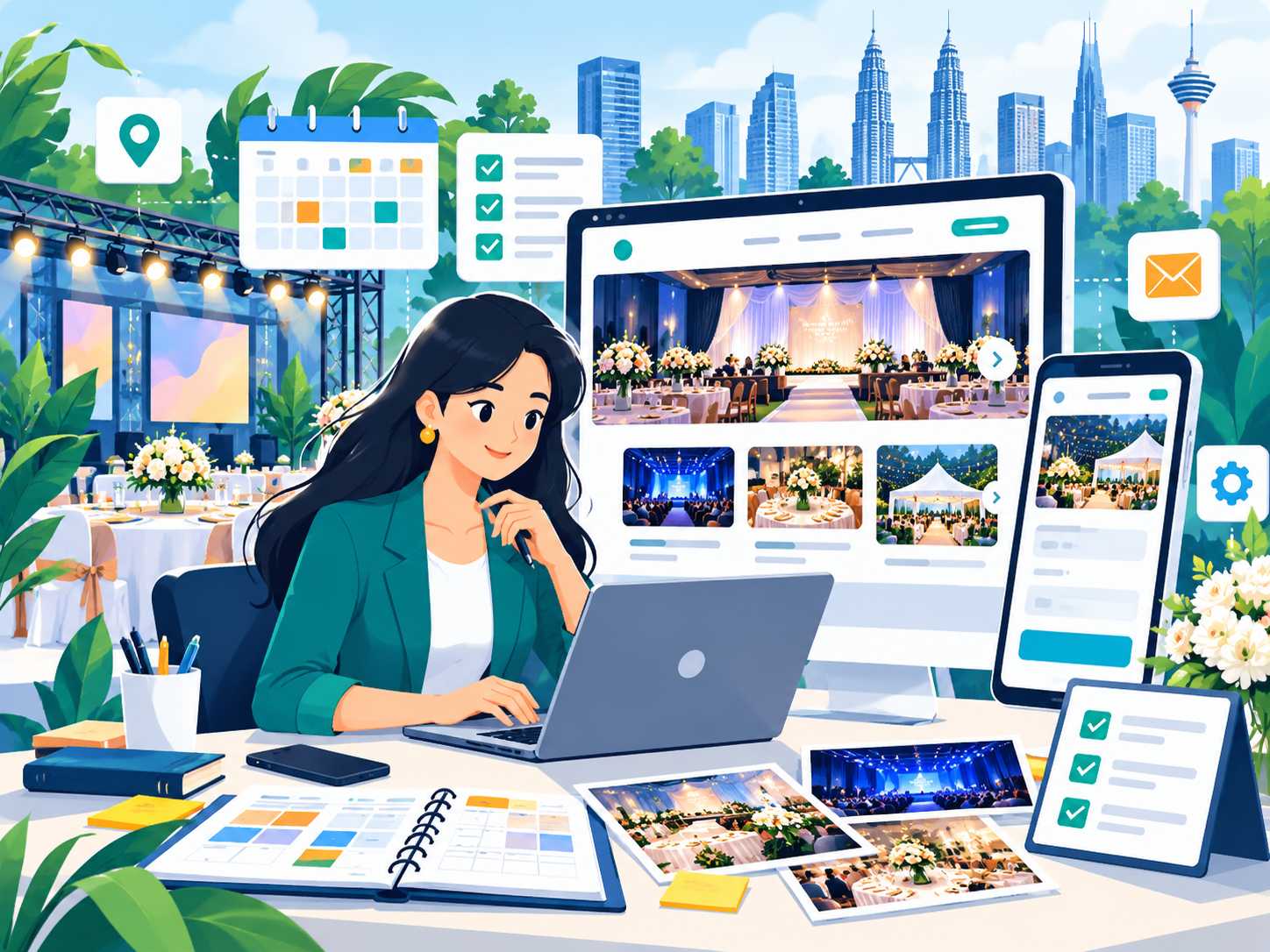
For an event management company in Malaysia, a website should be much more than a place to display your company logo, several event photos and a phone number.
Potential clients planning an annual dinner, conference, product launch, exhibition, corporate event or large-scale function usually want answers to several important questions before they are ready to contact you:
- What types of events can you manage?
- What services do you provide?
- What events have you handled before?
- What are your team's production and coordination capabilities?
- Which locations do you cover?
- Are you suitable for the type and scale of their event?
- How can they request a quotation or discuss their event requirements?
That is why an event company website should work as a combination of a company profile, service catalogue, event portfolio, credibility platform and lead-generation tool.
In this guide, we will look at the structure and features worth considering when building an event management company website in Malaysia, including how service pages, event portfolios, SEO, WhatsApp and enquiry flows can help prospective clients understand your business and take the next step.
Why Does an Event Management Company Need More Than Just a Beautiful Website?
The event industry is highly visual. Platforms such as Instagram, Facebook and TikTok can therefore be useful for showing recent events, short videos, behind-the-scenes content and event highlights.
However, social media and a business website serve different purposes.
Social media is useful for ongoing engagement and visual updates. Your website can become the main place where potential customers find structured information about your company, services and experience.
For example, a corporate buyer may use your website to review:
- Corporate event services.
- Conference management.
- Annual dinner planning.
- Product launches.
- Exhibitions and trade shows.
- Technical production.
- Previous projects.
- Client or industry experience.
- Your working process.
- Contact and quotation information.
This information can be difficult to evaluate if a potential customer has to search through months or years of social media posts.
A properly structured website gives them one central place to understand what your company can actually deliver.
1. Your Homepage Should Quickly Explain What Your Company Does
When someone lands on your homepage, they should be able to understand within a short time:
- Who you are.
- What types of events you manage.
- Who your target clients are.
- Which locations you serve.
- What they should do next.
Avoid relying only on generic hero messages such as:
“Creating unforgettable experiences.”
The message may sound attractive, but it still does not clearly explain what your business actually provides.
A more specific positioning statement could be:
Corporate Event Management for Conferences, Annual Dinners, Product Launches & Exhibitions in Malaysia
You can then support it with a clear call to action such as:
- Request a Quotation
- Discuss Your Event
- WhatsApp Our Team
- View Our Work
The objective is to remove basic uncertainty and help prospective clients quickly determine whether your company is relevant to their event.
2. Do Not Squeeze Every Service Into One Short Section
One common weakness of event company websites is placing every service into a single page or paragraph without explaining each area properly.
If your company genuinely provides different categories of event management services, consider creating clearer service or event-type pages.
Examples of service or event-type pages
- Corporate Event Management
- Annual Dinner & Awards Night
- Conference & Seminar Management
- Product Launch
- Exhibition & Trade Show
- Roadshow & Brand Activation
- Team Building
- Government Functions
- Wedding or Private Events, if genuinely offered
- Event Production & Technical Support
Not every event company needs all of these pages.
Create dedicated pages only for services that your company genuinely offers and where you have enough useful information to help prospective customers.
For each service page, consider explaining:
- What the service includes.
- Who it is suitable for.
- The types of events involved.
- Your scope of work.
- Your working process.
- Relevant portfolio projects.
- Frequently asked questions.
- How to request a quotation.
This structure also gives search engines clearer information about the individual services your company provides instead of relying on one generic page about event management.
3. Your Event Portfolio Is One of the Most Important Parts of the Website
In the event industry, potential clients naturally want to see visual proof of previous work.
However, a strong portfolio is more than a gallery containing dozens of photographs with no explanation.
Where appropriate, important projects should include some context.
Information you can include in an event portfolio
- Event name or event type.
- Client or industry type, where disclosure is allowed.
- Event location.
- Type of event.
- Approximate event scale or guest count where appropriate.
- Event objective.
- Your company's scope of work.
- Production or technical requirements.
- Main challenges.
- Your approach or solution.
- Real event photographs and videos.
For example, instead of showing only a photograph of a stage, you could provide context such as:
Corporate Leadership Conference — Kuala Lumpur
The project scope included event planning, stage setup, registration coordination, audiovisual production and on-site event management.
This gives the photographs meaning and helps prospective clients understand what your company was responsible for.
You can see examples of websites developed across different industries, including event-related businesses, in the Nibong Web Studio portfolio.
4. Organise Your Gallery by Event Type
Event companies often accumulate a large number of photographs.
If every image is placed inside one large gallery, potential clients may struggle to find examples relevant to their particular event.
Consider organising your work into categories such as:
- Corporate Events
- Annual Dinners
- Conferences
- Product Launches
- Exhibitions
- Roadshows
- Awards Ceremonies
- Government Events
- Private Events
This allows someone planning a conference, for example, to quickly review your conference experience without browsing through unrelated wedding, roadshow or private-event photographs.
Do not overlook image optimisation
Event photography can be one of your strongest website assets, but large image files can also make a website unnecessarily heavy.
Use clear, high-quality images that have been appropriately prepared for web use. File names and alt text should describe the image naturally and accurately.
For example, a descriptive filename such as:
corporate-annual-dinner-kuala-lumpur.jpg
is more meaningful than:
IMG_9382.jpg
Alt text should describe the image for users and accessibility rather than being filled with repeated SEO keywords.
5. Show the Types of Events You Are Actually Good At
A statement such as “We manage all types of events” sounds broad, but it may not help prospective clients understand your real strengths.
It is often more useful to communicate your actual areas of expertise.
For example, if corporate events are your main strength, your website could focus on areas such as:
- Annual dinners.
- Conferences.
- Leadership summits.
- Product launches.
- Awards ceremonies.
- Corporate retreats.
- Business networking events.
- Exhibitions.
- Government functions.
If your company mainly focuses on weddings, your website structure and content should naturally be different.
Your website should reflect your genuine business model rather than attempting to target every possible event-related keyword.
6. Clearly Explain Your Event Management Scope
The term “event management” can mean very different things from one company to another.
A customer may assume that you handle an entire event from beginning to end when your business actually provides only selected parts of the process.
Your website should therefore explain the capabilities you genuinely provide.
These may include:
- Event concept development.
- Venue sourcing.
- Event programme planning.
- Registration management.
- Guest management.
- Vendor coordination.
- Stage design.
- Sound systems.
- Lighting.
- LED screens.
- AV production.
- Emcee or entertainment coordination.
- Event branding.
- Photography and videography.
- On-site management.
- Post-event reporting.
There is no need to list services that your company does not provide.
The more accurate the information is, the easier it becomes for prospective customers to determine whether you are suitable for their event.
7. Explain Your Process From the Initial Brief to Event Day
For corporate clients, your working process can contribute to their confidence in your company.
They may want to know what happens after they submit an enquiry.
A simple event-management workflow could look like this:
- Initial Brief — understand the objectives, event type, date, location and estimated attendance.
- Concept & Proposal — develop the event direction, proposed scope and key requirements.
- Planning — coordinate the venue, vendors, programme, production, logistics and timeline.
- Pre-Event Coordination — complete final confirmations, rehearsals and technical checks.
- Event Execution — manage on-site coordination and delivery.
- Post-Event — complete wrap-up, documentation or reporting where included in the scope.
Your actual process may be different, but explaining it can reduce uncertainty before a potential client contacts you.
8. Your Enquiry Form Should Collect the Right Information
A simple form containing only “Name, Email and Message” may be too general for an event management company.
You can design your enquiry form to collect enough information for an initial event brief before your team follows up.
Information you may want to request
- Name.
- Company or organisation name.
- Phone number.
- Email address.
- Event type.
- Event date or preferred date.
- Location.
- Estimated number of attendees.
- Services required.
- Event objective.
- Estimated budget, if appropriate for your sales process.
- Additional requirements.
Avoid making the form unnecessarily long.
Ask only for information that genuinely helps your team understand and qualify the enquiry.
9. WhatsApp Can Still Be an Important Call to Action
For many Malaysian businesses, WhatsApp is a convenient way to begin a conversation with a potential service provider.
Your website could therefore use calls to action such as:
- Discuss Your Event on WhatsApp
- Get an Event Quotation
- Talk to Our Event Team
- Send Your Event Brief
You can also use a pre-filled WhatsApp message.
For example:
Hi, I would like to request a quotation for a corporate annual dinner in November for approximately 300 guests in Kuala Lumpur.
This gives your team more useful information than receiving only a generic “Hi”.
10. Use Client Logos, Testimonials and Trust Signals Responsibly
Corporate buyers may want to understand the types of organisations that have previously trusted your company with their events.
Where you have permission and valid evidence, your website may include:
- Client logos.
- Testimonials.
- Relevant certifications.
- Industry memberships.
- Media coverage.
- Event partnerships.
- Awards.
Only display information that is genuine and supportable.
Do not use fabricated testimonials, display organisations that were never your clients, or make claims such as “500+ successful events” unless you can support the claim.
Real evidence is more valuable for building trust than impressive-looking numbers with no clear basis.
11. Your About Us Page Should Show Who Is Behind the Events
Event management depends heavily on people, coordination and execution.
Your About Us page therefore does not need to be limited to a long company history.
You could include:
- Company leadership.
- Core team members.
- Areas of expertise.
- Types of events commonly handled.
- Service areas.
- Business philosophy.
- Relevant experience.
If customers will be dealing directly with particular project managers, producers or coordinators, short professional profiles can also help establish confidence.
12. Clearly Define Your Service Areas
An event company may be based in Kuala Lumpur but also manage events in Selangor, Penang, Johor, Sabah or Sarawak.
Clearly state the areas you genuinely serve.
Avoid creating dozens of almost identical city pages simply to target location names.
If you genuinely operate in a particular area and have enough useful information, a dedicated local page may be appropriate.
For example, a Kuala Lumpur page could discuss:
- The types of corporate events you manage there.
- Your actual service coverage.
- Relevant venue types.
- Relevant portfolio work.
- Local event logistics considerations.
This provides more value than copying the same page and replacing “Kuala Lumpur” with “Penang”.
13. SEO for an Event Management Company Starts With Website Structure
Many business owners assume that SEO simply means publishing blog articles.
For an event management company, however, an important part of SEO is ensuring that each important search intent has the appropriate type of page.
For example:
| Potential Customer Search | Suitable Page Type |
|---|---|
| event management company malaysia | Main service page or homepage |
| corporate event management malaysia | Corporate event service page |
| annual dinner event company | Annual dinner service page |
| conference organiser malaysia | Conference service page |
| event company kuala lumpur | Relevant local or service page where genuinely appropriate |
| how to plan corporate annual dinner | Informational blog article |
This is commonly referred to as keyword-to-page mapping.
It helps avoid a situation where multiple pages on your own website are all trying to target the same primary search intent.
If organic search visibility is one of the goals for your new website, you can also review the SEO services provided by Nibong Web Studio.
14. Event Portfolio Projects Can Support SEO When They Include Context
A portfolio page containing 30 photographs may look impressive but still provide very little information about the actual work completed for each project.
For selected events, consider building more detailed case study or project pages.
For example:
Annual Dinner for a Manufacturing Company in Selangor
You could then explain:
- Event objective.
- Guest count.
- Event format.
- Scope of work.
- Stage and technical production.
- Programme requirements.
- Event photographs.
This gives potential customers genuinely useful information while also providing search engines with better context about the work your company performs.
15. Build Content Around Real Customer Questions
Once your core service pages are strong, your blog can be used to answer questions prospective clients commonly research before requesting a quotation.
Examples of useful content topics
- How Much Does a Corporate Annual Dinner Cost in Malaysia?
- Corporate Annual Dinner Planning Checklist
- Conference Planning Checklist for Corporate Events
- How Long Does It Take to Plan a Corporate Event?
- Event Planner vs Event Management Company: What Is the Difference?
- What Should Be Included in an Event Brief?
- Venue Selection Checklist for Corporate Events
- Questions to Ask Before Choosing an Event Management Company
- How to Plan a Product Launch
- Corporate Event Budget: What Costs Should You Consider?
Content like this can reach potential customers during the research stage before they are ready to request a quotation.
However, avoid publishing articles simply to accumulate more keywords. Every article should answer a genuine question and have a clearly defined search intent.
16. Mobile Experience Is Especially Important for Event Websites
Event websites often contain large amounts of visual media, including:
- High-resolution photography.
- Video.
- Animation.
- Image galleries.
- Background video.
If these assets are added without proper optimisation, the website can become unnecessarily heavy, particularly for mobile visitors.
Your website should:
- Work properly across mobile screen sizes.
- Provide simple and clear navigation.
- Use appropriately optimised images.
- Keep text easy to read without zooming.
- Make important CTA buttons easy to tap.
- Display galleries properly on smaller screens.
- Avoid unnecessary animation that interferes with usability.
An event website does not need to sacrifice performance simply because the industry is visual.
Design and optimisation should work together.
17. Video Can Be Powerful, but Do Not Make the Website Unnecessarily Heavy
A highlight video from a conference, annual dinner or product launch can provide strong visual evidence of your work.
However, that does not mean several high-resolution videos need to autoplay as soon as someone opens the homepage.
Consider techniques such as:
- Showing a thumbnail before loading the video.
- Using suitable video hosting.
- Compressing media appropriately.
- Lazy loading where appropriate.
- Using poster images.
- Placing longer videos on relevant portfolio pages.
The goal is to create a strong visual experience without making visitors wait unnecessarily for the website to load.
18. Consider a Bilingual Website Based on Your Target Audience
If your company works with both Malaysian and international corporate clients, a Bahasa Malaysia and English website may be useful.
However, avoid relying entirely on unreviewed automatic translations.
Many event-industry terms are commonly used in English even during Bahasa Malaysia business conversations, including:
- event management
- annual dinner
- conference
- product launch
- roadshow
- event production
- AV
- stage setup
- registration
Your content should reflect the language your real customers naturally use rather than forcing awkward translations of familiar industry terminology.
19. Landing Page or Full Website for an Event Company?
The right choice depends on your objective.
A landing page may be enough when:
- You are promoting one particular event.
- You are running a specific advertising campaign.
- You only need registration for one event.
- You provide one highly specialised service.
A full website is usually more suitable when:
- Your company provides multiple event services.
- You want to develop a long-term project portfolio.
- You want to generate enquiries through Google.
- You need to show multiple case studies.
- You want to publish useful content.
- You need stronger corporate credibility.
For an event management company that wants to develop its brand and generate business enquiries over the long term, a multi-page website usually provides more room for dedicated services, portfolios, company information, SEO content and enquiry pathways.
You may also find our guide to building a corporate website in Malaysia useful when planning the overall structure of your business website.
20. Example Structure for an Event Management Company Website
The exact structure should depend on your actual services, but a typical website could include:
- Home
- About Us
- Services
- Corporate Events
- Annual Dinner
- Conference Management
- Product Launch
- Exhibition
- Event Production
- Our Work / Portfolio
- Case Studies
- Clients / Testimonials
- Blog / Insights
- FAQ
- Contact / Request Quotation
A smaller event company may begin with a simpler structure and expand the website as its services and project portfolio grow.
21. What Should You Prepare Before Asking a Web Designer to Build the Website?
A website project normally moves more smoothly when important business materials are prepared early.
For an event management company, consider preparing:
- Company profile.
- High-quality logo files.
- Brand guidelines, if available.
- List of services.
- List of event types.
- Service areas.
- Company contact information.
- Team profiles.
- Client logos you have permission to display.
- Testimonials.
- Portfolio photographs.
- Event videos.
- Project descriptions.
- Social media links.
- Frequently asked questions.
- Your preferred enquiry process.
If you have a specific launch deadline connected to an exhibition, conference, product launch or other upcoming event, communicate this to your web designer early in the project.
For more information about the development process, read our guide on how long it takes to build a website in Malaysia.
22. Common Event Management Company Website Mistakes
Relying only on Instagram
Instagram can be an excellent marketing channel, but potential clients conducting more detailed research may still want to review an official business website.
Using a gallery with no context
Beautiful photographs alone do not necessarily explain what your team actually managed or delivered.
Putting every service on one page
If your business offers several substantial services, one generic page may make it more difficult for users and search engines to understand your areas of specialisation.
Using too much animation
An event website does not need every section to move. Use animation where it improves the experience rather than distracting visitors from important information.
Uploading oversized photographs
Large event photographs uploaded directly from a camera can significantly increase page weight if they are not prepared for web use.
Making the contact button difficult to find
After reviewing your portfolio, a prospective customer should have a clear way to start an enquiry.
Not showing real project evidence
Generic stock photographs do not provide the same level of evidence as genuine event portfolio work.
Making claims that cannot be supported
Avoid claims such as “No. 1 event company in Malaysia” or “Malaysia's best event company” unless you have a credible basis for making them.
23. What Makes a Good Event Management Company Website?
A good website is not necessarily the one with the most animation or the most elaborate visual effects.
A useful website helps potential customers answer questions such as:
- Does this company manage my type of event?
- Do they have relevant experience?
- What exactly can they manage for me?
- Does their previous work meet the standard I need?
- Where do they operate?
- How does their process work?
- How can I request a quotation?
If your website answers these questions clearly, potential customers have more information to evaluate your business before speaking with your team.
24. Your Event Website Should Also Support Your Sales Team
Your website should not be built only for Google.
Your sales team can also use it during proposals, networking, prospecting and follow-up conversations.
For example, instead of sending 20 separate photographs through WhatsApp, your sales team could send a direct link to:
- A corporate events portfolio.
- Conference projects.
- Annual dinner projects.
- Technical production capabilities.
- A relevant case study.
This allows the website to function as part of your sales process rather than simply being an online brochure.
25. How Can Nibong Web Studio Help?
Nibong Web Studio provides website design services for Malaysian businesses, with a focus on clear website structure, mobile-friendly design, SEO foundations and practical enquiry pathways.
For an event management company, your website structure can be planned around factors such as:
- The types of events you provide.
- Your corporate or consumer target market.
- Dedicated service pages.
- Portfolio structure.
- Photo and video galleries.
- WhatsApp integration.
- Quotation or event brief forms.
- SEO structure.
- Blog functionality where required.
- Bahasa Malaysia and English content where suitable.
You can review websites developed for different industries through the Nibong Web Studio portfolio.
If you would like to understand the available website packages first, visit our website pricing page.
Frequently Asked Questions About Event Management Company Websites
Does an event management company really need a website?
Not every event business needs a large website, but a professional website can provide one controlled platform for organising your services, event portfolio, company information and enquiry process. It can also support SEO, sales conversations and corporate credibility.
How many pages does an event company website need?
There is no fixed number. A smaller company may begin with Home, About, Services, Portfolio and Contact pages. Companies offering multiple substantial services may benefit from dedicated pages for conferences, annual dinners, product launches, exhibitions and other key services.
Should I display event prices on the website?
Not necessarily. Event pricing can depend on factors such as the venue, date, number of guests, production requirements, equipment, catering and project scope. Instead, you may explain what affects pricing and provide a quotation form for customised requirements.
Does my website need an online booking system?
Not necessarily. Corporate events often require discussion, planning and customised quotations. An enquiry form, WhatsApp or consultation process may be more appropriate than instant booking. Online registration may still be useful for specific events when required.
Can I use Instagram as my only portfolio?
Instagram can be useful for social marketing, but a website gives you more control over how your portfolio is organised. You can categorise work by event type, add project details, connect projects to relevant service pages and provide clearer enquiry pathways.
Does an event company need a blog?
Not necessarily at the beginning. Prioritise your homepage, service pages and portfolio first. A blog can be added when you are ready to build organic visibility by answering real questions that potential clients search for.
Is SEO important for an event management company?
SEO can be valuable when potential customers use Google to search for services such as corporate event management, annual dinner organisers, conference organisers or event companies in specific locations. Your website still needs appropriate pages and useful content that match those search intentions.
Can an event website use lots of photographs and videos?
Yes, but visual media should be appropriately optimised so the website remains usable on mobile devices and does not become unnecessarily heavy. Use event photography and video strategically rather than uploading every media file without optimisation.
Should an event management company have a bilingual website?
It depends on your audience. If your business serves both local and international clients, Bahasa Malaysia and English versions may be useful. Each version should read naturally for its intended audience rather than relying only on automatic translation.
Conclusion
An event management company website in Malaysia should be more than a digital company profile.
A properly planned website can help potential clients:
- Understand the types of events you manage.
- Review your services and capabilities.
- Evaluate real portfolio work.
- Understand your working process.
- Review relevant trust signals.
- Submit a more useful and qualified enquiry.
For most event companies, the first priority should be clear positioning, accurate service pages, well-structured portfolio content, optimised visual media, a strong mobile experience and easy-to-use calls to action.
Once these foundations are in place, SEO content, Local SEO, case studies and useful blog articles can be developed to increase your visibility for relevant searches.
If you are planning a new event management website or want to improve an existing website, contact Nibong Web Studio and share your event services, target customers and website requirements. We can help you plan a website structure that better supports your business.
Ready to build your website?
Tell us about your business and we will recommend the right package.